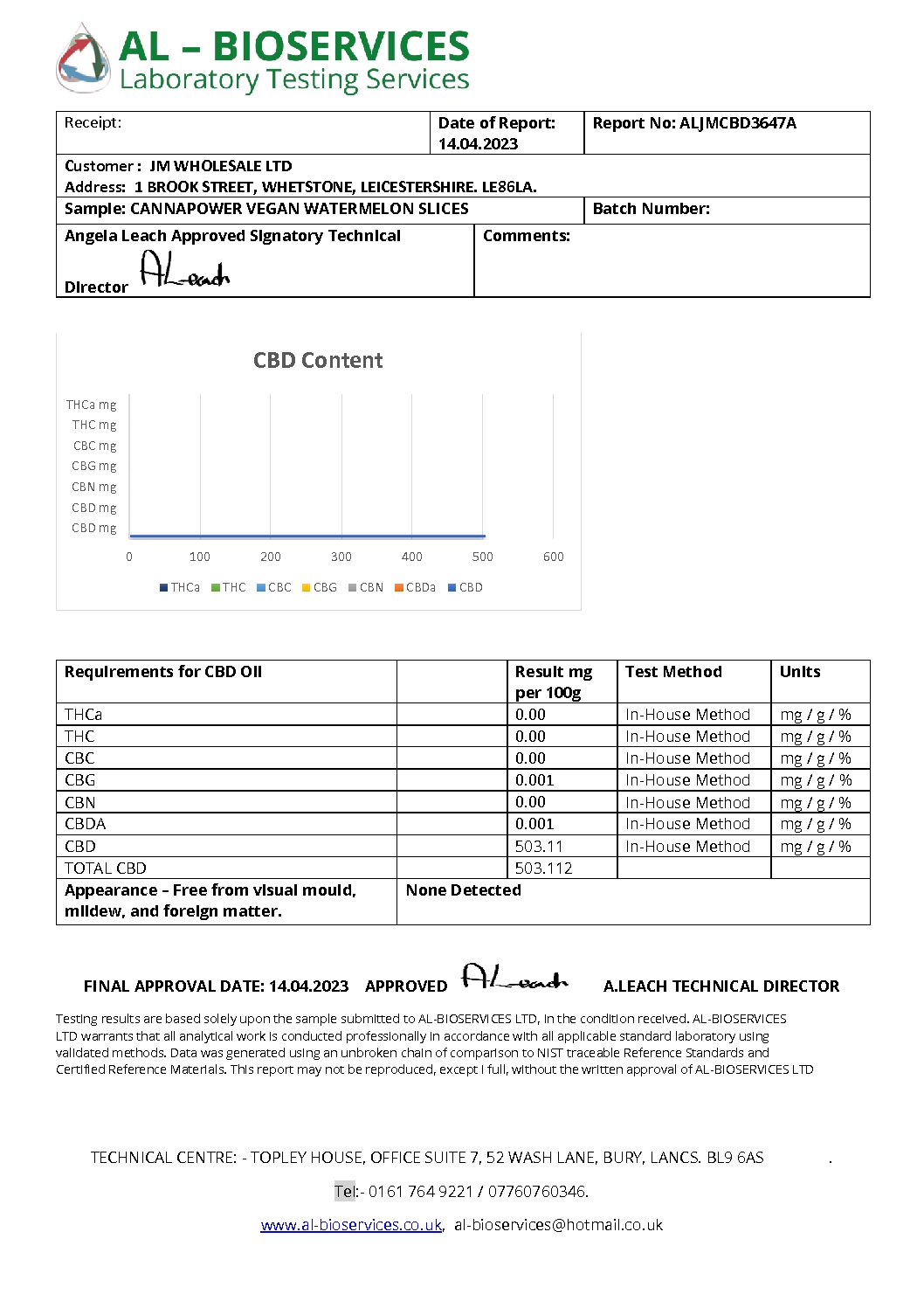
Every CBD product we sell has a lab report linked on its product page. Most people never click it. The ones who do often come into the shop holding their phone up and asking, “what am I actually looking at?” It’s a page full of abbreviations, percentages and “ND”s, and nobody explains it.
That’s a shame, because a lab report (also called a certificate of analysis, or COA) is the best way to check a CBD product contains what it says and nothing it shouldn’t. It’s not as hard to read as it looks.
Why lab reports matter
Because the label isn’t always right. When the Centre for Medicinal Cannabis had 30 CBD oils from UK shops independently tested in 2019, 38% contained less than half the CBD they advertised, one contained none at all, and 45% had measurable THC. A later study of UK products in 2023 again found that many contained less CBD than their labels claimed, and that how far off they were didn’t depend on price.
Shoppers clearly care about this. In the FSA’s survey of CBD users, published in December 2025, 91% said trust in the brand or retailer was important to them, and the same proportion said product strength and value for money mattered. A lab report is how a seller backs that trust up.
What is a certificate of analysis?
A COA is a document from a laboratory showing the results of tests on a specific batch of a product. A good one comes from an independent, third-party lab, meaning not the brand’s own lab, and ideally one accredited to ISO/IEC 17025, the international standard for testing laboratories (in the UK, accreditation is done by UKAS).
How to read a CBD lab report, section by section
1. The header: who, what and when
At the top you should find:
- The lab’s name and contact details, and its accreditation if it has one.
- The product name and, ideally, a batch or lot number. That number should match the one printed on your bottle or tub.
- The date tested. A report from four years ago tells you little about a bottle made last month.
- The sample type, for example “oil”, “gummy” or “cream”.
2. The cannabinoid profile
This is the main table. It lists cannabinoids down the side, usually CBD, CBDA, CBG, CBN, CBC, THC (sometimes written Δ9-THC) and THCA, with a result for each.
Results are usually given in one of these units:
- % (percent): grams per 100g of product.
- mg/g: milligrams per gram. 1% equals 10mg/g.
- mg/ml: milligrams per millilitre, common for oils.
- mg per unit: per gummy or capsule, if the lab has tested whole units.
3. “ND” and “LOQ”
You’ll see these a lot.
- ND means “not detected”: the lab didn’t find any at all, at least not above the level its equipment can see.
- LOQ (limit of quantification) or LOD (limit of detection) is the smallest amount the lab can reliably measure or detect. A result of “<LOQ” means a trace may be there but it’s too small to measure accurately.
“ND” for THC is what you want to see on an isolate or broad spectrum product.
4. Total CBD
Some reports add a “total CBD” figure, which combines CBD and CBDA (the raw acid form, which turns into CBD when heated). Check this against the label.
5. Terpenes (sometimes)
Full and broad spectrum products sometimes include a terpene profile, listing aromatic compounds like myrcene or limonene. It’s useful if you’re interested in the fuller hemp profile, but not essential.
6. Contaminants (on the better reports)
The most thorough reports also test for:
- Heavy metals, such as lead, cadmium, mercury and arsenic. Hemp absorbs these from the soil.
- Pesticides.
- Residual solvents, left over from extraction.
- Microbes, such as mould, yeast and bacteria.
Each should be marked “pass”, or show a result below the stated limit.
Worked example: does the strength match the label?
Say you’ve bought a 10ml bottle labelled 1000mg CBD. That’s 100mg per ml, or 10%.
If the report says CBD: 101 mg/ml, that’s spot on. If it gives a percentage, remember that oil weighs a little less than water (a 10ml bottle of oil weighs roughly 9g), so a result of around 11% by weight is also about right. A result of 4% would mean the bottle contains well under half what’s on the label.
Labs and manufacturers usually allow a small tolerance either way. Within about 10% of the label is a reasonable expectation.
Worked example: is the THC within the UK limit?
The UK rule is no more than 1mg of THC (and other controlled cannabinoids) per container. Here’s how to check it.
- Find the THC result. Let’s say it’s 0.002%.
- Work out the weight of the product. A 10ml oil weighs about 9g.
- Multiply: 0.002% of 9g is 0.00018g, which is 0.18mg.
- Compare: 0.18mg is under 1mg, so this bottle is within the limit.
Now try the same with a THC result of 0.02%: that’s 1.8mg in the bottle, which is over the UK limit, even though it would pass the US “0.3%” rule easily. This is why some full spectrum products made for the American market can be illegal here.
For bigger containers the maths matters even more. A 30ml bottle holds three times as much oil as a 10ml one, so the same THC percentage means three times as much THC.
Red flags
- No report at all, or “available on request” with no reply when you ask.
- No batch number, or a batch number that doesn’t match your product.
- An old date.
- A report for a different product, or the same report used for several strengths.
- No lab name, or a lab you can’t find online.
- CBD well below the label, or THC above 1mg per container.
- A blurry screenshot or an edited-looking PDF. You can usually contact the lab to check a report is genuine.
How we handle lab reports
Every product page on our site links to the lab report for that product. If you’re in the shop, ask and we’ll show you on the spot and go through it with you. If something doesn’t look right to you, tell us. We’d much rather answer a question than lose a customer’s trust.
Browse our CBD and CBG oils, gummies and skin care, or read Buying CBD oil in the UK and How to choose CBD gummies for more help choosing.
FAQs
What does COA stand for?
Certificate of analysis. It’s the lab report showing what’s in a specific batch of a product.
Does every CBD product need a lab report?
There’s no single law saying a retailer must publish one, but any reputable seller should be able to show you one. Without it, you’re taking the label on trust.
What’s the difference between CBD and CBDA on a report?
CBDA is the raw acid form found in the plant. It turns into CBD when heated. Some products, especially raw or cold-pressed ones, contain both.
Why does my full spectrum oil show THC?
Full spectrum products keep everything from the hemp extract, including trace THC. That’s fine as long as the total is no more than 1mg in the container. If you want none, choose broad spectrum or isolate.
Can I trust a report the brand did itself?
An in-house test is better than nothing, but an independent, accredited lab is much more reliable.
Where can I see the lab reports for your products?
On each product page, or ask to see them in the shop.
General information only. CBD products are sold as food supplements or cosmetics, not medicines, and are not intended to diagnose, treat, cure or prevent any disease. The FSA advises healthy adults to have no more than 10mg of CBD a day from food products.
References
- Centre for Medicinal Cannabis (2019). Independent testing of 30 UK CBD oils, reported by NORML. norml.org
- Advertised versus actual CBD content in UK products (2023). https://pmc.ncbi.nlm.nih.gov/articles/PMC10339496/
- Food Standards Agency / Ipsos (December 2025). Use of CBD products. science.food.gov.uk
- Home Office. Drug licensing factsheet: cannabis, CBD and other cannabinoids. gov.uk
- The Misuse of Drugs Regulations 2001, regulation 2 (exempt products). legislation.gov.uk
- UKAS. Testing laboratory accreditation (ISO/IEC 17025). https://www.ukas.com/
- Food Standards Agency. Cannabidiol (CBD). https://www.food.gov.uk/safety-hygiene/cannabidiol-cbd