We wrote this for anyone who’s a bit lost with CBD and CBG: what they are, how they differ, what the numbers on the bottle mean, and what the UK rules say. It’s general information rather than medical advice.
The short version
CBD (cannabidiol) and CBG (cannabigerol) are natural compounds from hemp, and neither will get you high. In the UK they’re sold as food supplements or cosmetics, not medicines, so nobody selling them can say they treat or prevent anything. The Food Standards Agency (FSA) advises healthy adults to have no more than 10mg of CBD a day.
Cannabinoids
These are natural compounds in the cannabis plant, and hemp is a type of cannabis. Over 100 have been found. The two most people have heard of are THC, which gets you high and is a controlled drug in the UK, and CBD, which doesn’t.
The endocannabinoid system
Your body has its own endocannabinoid system (ECS). It’s made up of receptors called CB1 and CB2, molecules your body makes that are similar to cannabinoids, and the enzymes that break them down. How plant cannabinoids like CBD and CBG interact with it is still being researched.
CBD
The most common cannabinoid in hemp that doesn’t get you high. It’s extracted from the plant and goes into oils, gummies, creams, vapes and teas.
CBG
You’ll sometimes hear CBG called the “mother cannabinoid”. Young hemp plants contain CBGA, which turns into the acid forms of CBD, THC and CBC as the plant grows, leaving only a little CBG behind. That’s why it’s rarer than CBD and usually costs more. The research on CBG is still at an early stage.
Side by side
| CBD | CBG | |
|---|---|---|
| In hemp | Plenty, in mature plants | Small amounts |
| Gets you high? | No | No |
| Price | Lower per mg | Higher per mg |
| What we sell | Oils, gummies, creams, vapes, teas | Oils, creams, vape cartridges (with CBD) |
Full spectrum, broad spectrum, isolate
Full spectrum has CBD plus the plant’s other natural compounds, including a trace of THC. Broad spectrum is the same idea with the THC taken out. Isolate is CBD and nothing else.
Under UK rules, a legal CBD product can’t contain more than 1mg of controlled cannabinoids like THC per container.
Picking a format
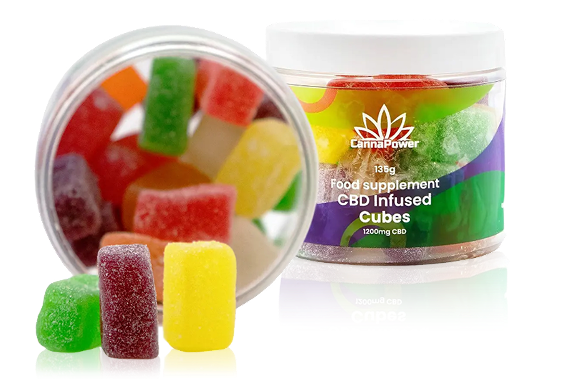
It mostly comes down to habit. Oils go under the tongue and you can adjust them a drop at a time. Gummies and sweets are already measured out. Creams and balms are cosmetics for skincare and massage. Vape cartridges are for adults who vape. And CBD tea has a fixed amount in every bag.
Making sense of % and mg
Lots of oils show a percentage, like 5% or 10%. What you really want to know is the total mg of CBD and how much is in each drop. A 5% oil in a 10ml bottle has 500mg of CBD. The same 5% in a 30ml bottle has 1500mg, three times as much.
A typical pipette holds 15 to 20 drops. Here’s roughly what each drop contains in a 10ml bottle, and how many drops get you to the FSA’s 10mg:
| Total CBD (10ml) | Strength | CBD per drop | Drops for 10mg |
|---|---|---|---|
| 500mg | 5% | about 2.5mg | About 4 |
| 1000mg | 10% | about 5mg | About 2 |
| 1500mg | 15% | about 7.5mg | 1 |
| 2000mg | 20% | about 10mg | 1 |
| 2500mg | 25% | about 12.5mg | One drop is already over |
| 3000mg | 30% | about 15mg | One drop is already over |
| 3500mg | 35% | about 17.5mg | One drop is already over |
Drop sizes vary, so take these as rough figures and check your own label.
Safety and the rules
Besides the 10mg a day advice, the FSA says CBD isn’t recommended for under-18s, anyone pregnant, breastfeeding or trying to conceive, or anyone on medication unless a doctor says otherwise, because CBD can interact with some medicines. CBD food products also have to be on the FSA’s public list. There’s more on the FSA website.
Pets
The Veterinary Medicines Directorate treats CBD products for animals as veterinary medicines. Please talk to your vet before giving your pet any CBD.
CBD with mushroom supplements
Some of our customers take CBD as well as mushroom supplements. If that’s you, start one product at a time, stick to the amount on each label, and check with your GP first if you take medication. Our mushroom guide has more.
CBD and CBG products are food supplements or cosmetics, not medicines, and are not intended to diagnose, treat, cure or prevent any disease.